% open battery-brief
Battery Brief
A daily intelligence brief on the battery (secondary-cell) value chain, researched and fact-checked by AI, in the inbox before the market opens.
PROBLEM
A finance professional covering the Korean battery sector has to read the whole value chain every morning — policy, subsidies, capacity, supply and demand, the listed names — across scattered Korean and US sources, and have a view before the market opens. Doing it by hand is an hour of reading every day, and the one morning you skip it is the morning something moved.
WHAT I BUILT
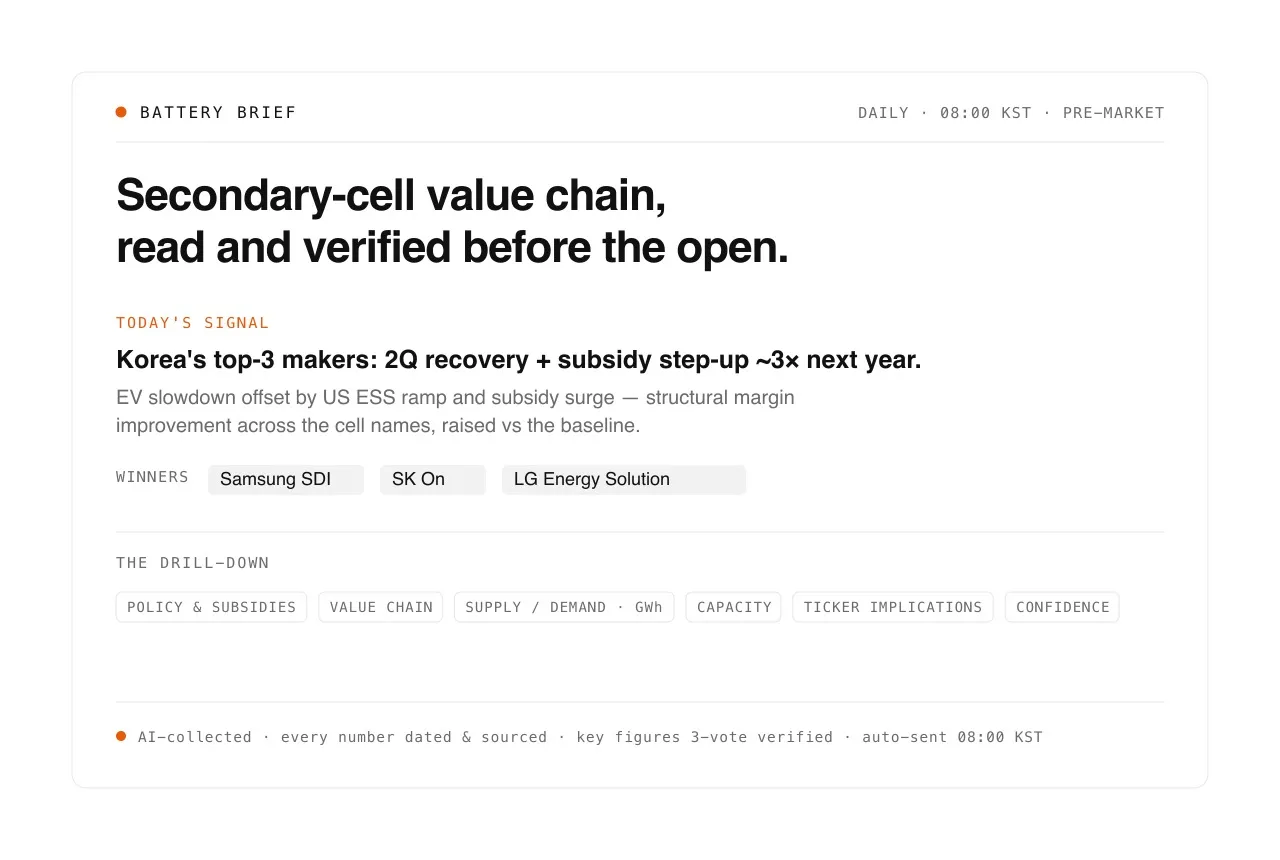
An automated daily brief that does that reading for him. It runs itself before the market opens, pulls the overnight news, checks it against a living model of the value chain, and writes a two-speed brief: a short 'Today's Signal' up top — what happened, why it matters, who wins and who loses — then a drill-down for anyone who wants the detail (policy & subsidies, value chain, supply/demand in GWh, capacity & capital raises, ticker implications, and a confidence note). Every number is dated and sourced, and the important ones are checked three times before they're allowed in.
HOW IT WORKS
It's cheap-where-it-can-be and rigorous-where-it-must-be. A weekly deep-dive rebuilds a living database of the value chain — supply/demand, policy, who makes what — and the daily run just reads that, searches the overnight session, and writes the brief against it. Key figures get a three-vote adversarial check: the number only ships if it survives. It renders the brief plus a hosted dashboard and a source sheet where every supply/demand figure shows its origin and its verification, then emails the brief — and if the data ever fails to validate, it sends nothing rather than send something wrong. The whole pipeline is scheduled to fire at 8am Korea time, before the market opens, so it captures the US overnight and lands first thing.
WHERE IT'S AT
Live. It runs on a schedule every morning and has been delivering real briefs end to end. The reader — a banker who verifies numbers like a real user — has been engaging with it, including asking for the source references behind the supply/demand figures, which it now ships as a dedicated sheet.
WHAT I LEARNED
In finance, trust is the product. A pretty brief that's wrong once is worse than no brief — so the hard engineering went into the boring, invisible parts: dating every figure, citing it, three-vote-checking the load-bearing numbers, and refusing to send anything when the data doesn't validate. The reader's first real question wasn't about the design, it was 'where did this number come from' — which is exactly the right question, and the reason the source sheet exists.
STACK
Claude (headless CLI) · Node · Python · launchd · Vercel
$ ./daily-run.sh        # launchd · 08:00 KST · pre-market open
[pulse]   reading value-chain · supply-demand · policy DB
[search]  US overnight session + newswire ... 17 items
[verify]  key numbers · 3-vote adversarial ... OK
[signal]  Korea top-3 battery: 2Q recovery + subsidy ~3x next yr
[render]  brief + dashboard + source sheet
[publish] dashboard live · supply/demand references live
[send] brief delivered ✓ 08:00 KST% cd ..